Most buyers make the same mistake at the start. They look for intensity first and control second. That is backwards. If you want to know how to choose protection rottweiler prospects the right way, start with stability, handler responsiveness, and proven working structure. Real protection is not about a dog that looks intimidating. It is about a dog that can live safely with your family, remain neutral in normal situations, and respond decisively when a real threat appears.
A serious protection Rottweiler should make your life safer, not more complicated. That means the dog must have clear-headed temperament, reliable obedience, environmental confidence, and training that holds up outside a field or kennel. For most buyers, the best dog is not the hardest dog. It is the most balanced one.
How to choose protection rottweiler for real life
The first question is not whether the dog can bite. The first question is whether the dog can think. A protection dog that cannot settle in the home, travel calmly, ignore harmless distractions, and switch cleanly between neutrality and action is a liability. In real life, control matters more than display.
This is where many buyers get pulled in the wrong direction. Videos of dramatic bite work can be impressive, but they do not tell you how the dog handles children, guests, pressure, slick floors, loud environments, or a handler with average experience. A qualified protection Rottweiler should show confidence without chaos. The dog should not be nervy, suspicious of everything, or difficult to turn off.
Temperament is the foundation. Training builds on it, but training cannot permanently fix weak nerves, poor judgment, or unstable drives. If the genetics are wrong, the finished product will always have limits.
Temperament comes before appearance
A strong head, dark markings, and heavy bone may appeal to buyers, but protection work is not a beauty contest. If you are choosing between a better-looking dog and a better-working dog, the working dog is the correct choice every time.
The right temperament includes social stability, confidence under pressure, willingness to engage, and the ability to recover quickly after stress. You want a dog that is serious when needed but not constantly searching for conflict. There is a difference between a protective dog and an unstable one. Experienced trainers know that distinction immediately. Inexperienced buyers often do not.
A stable protection Rottweiler should be able to do ordinary things well. Walking through a parking lot, loading into a vehicle, holding obedience around distractions, and remaining composed around normal visitors are all part of the picture. These are not minor details. They are daily proof of a usable dog.
What balanced drives look like
Drive is often misunderstood. High drive alone is not the goal. A dog with excessive drive and weak control can be difficult for a household to manage. A dog with too little drive may look obedient but fail under real pressure.
Balanced drive means the dog has enough defensive courage, prey engagement, and working intensity to perform protection tasks, while still staying clear in the head and responsive to commands. The dog should show commitment without becoming frantic. That balance is what makes a protection dog practical for a family, homeowner, or executive buyer.
Pedigree matters, but only if it is proven
A good pedigree is not a marketing decoration. It is evidence of selection. When evaluating a protection Rottweiler, look for breeding rooted in working standards, nerve quality, health, and trainability. Titles and certifications matter when they reflect real working ability and not just paperwork.
IGP-oriented breeding can be useful because it gives a structured view of drives, obedience, courage, and character. Still, pedigree alone does not guarantee the right dog for your needs. A strong bloodline increases the odds. It does not replace direct evaluation.
Health should also be part of the conversation. Hips, elbows, overall structure, and physical soundness affect both performance and longevity. A protection dog is an investment in safety and companionship. If the dog is not bred responsibly, you may inherit expensive and avoidable problems later.
Trained dog or green dog
This is one of the most important buying decisions. A green dog may cost less up front, but it comes with more uncertainty. You are paying for potential, not a finished result. Unless you have serious working-dog experience and access to a qualified trainer, a green prospect is usually the wrong fit for a buyer seeking immediate, dependable protection.
A trained protection Rottweiler offers more clarity. You can evaluate obedience, control, targeting, environmental confidence, social behavior, and handler transfer. You can see what the dog actually is, not what someone hopes it becomes.
That does not mean every trained dog is right. Training quality varies. Some dogs are trained for demonstration, not real-life function. Others are too equipment-focused and do not generalize well. Ask whether the dog has been worked in different environments, around real distractions, and with civilian handling in mind. A dog that only performs with one decoy or one handler is not fully prepared.
The trainer or breeder matters as much as the dog
If you are learning how to choose protection rottweiler candidates, understand this clearly: the source is part of the product. The breeder or trainer is responsible for genetics, early development, selection, and training standards. A serious working-dog program should be able to explain why the dog was bred, how the dog was raised, what pressures the dog has been tested under, and what type of owner the dog is suited for.
You should expect direct answers, not sales language. Ask how the dog handles guests. Ask whether the dog has lived in a home. Ask how the dog travels. Ask what kind of maintenance training is required. Ask where the dog is strong and where it has limits. Honest professionals do not promise that every dog fits every buyer.
A credible provider will also care about placement. Protection dogs are not impulse purchases. Matching dog to owner is part of responsible service. If a seller is willing to place a high-level dog with anyone who can pay, that is a warning sign.
What to evaluate in person
When you meet a dog, pay attention before any protection work starts. Watch how the dog exits the kennel or vehicle. Watch how it engages with the handler. Look for clean obedience, calm transitions, and environmental awareness without unnecessary agitation.
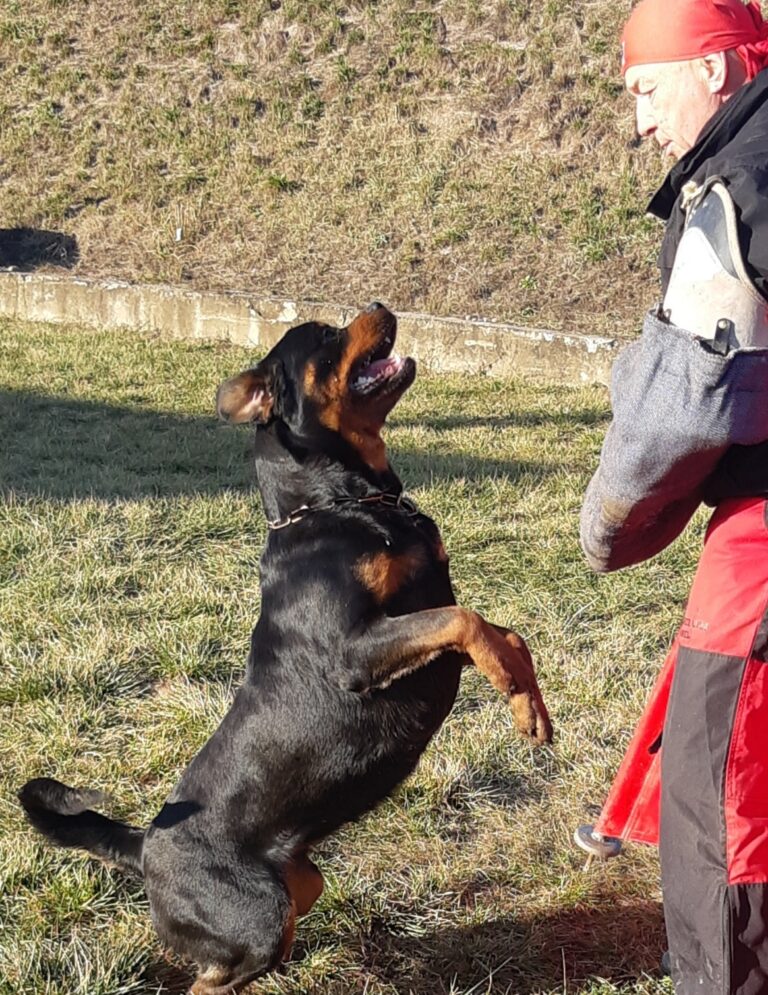
Then watch the dog work. You want to see commitment, grip quality, courage, and responsiveness under command. Just as important, watch the out, the recall, and the return to neutrality. The bite is only half the picture. Control after pressure tells you far more.
If possible, observe the dog in normal settings too. A protection dog should not look unstable in public or be difficult to manage around harmless activity. Real security comes from a dog that can distinguish between routine life and genuine threat.
Common buyer mistakes
Many buyers overvalue size, overreact to flashy aggression, and underestimate the importance of owner support. Bigger is not always better. More reactive is not more protective. And even a well-trained dog needs a clear transition plan with the new owner.
Another common mistake is buying based on fear. People who have had a security scare sometimes rush into the most intense dog available. That usually leads to mismatch. The better approach is to define your actual environment, family structure, property layout, and experience level, then select the dog that fits those realities.
Matching the dog to your household
The right protection Rottweiler for a single-property owner may not be the right dog for a home with young children, frequent guests, or regular travel. This is where real consultation matters.
A family dog needs strong social discrimination and excellent off-switch behavior. A dog for a rural property may need more territorial presence. An executive protection placement may require greater neutrality in public and stronger travel composure. The dog should be selected for your lifestyle, not just your security concerns.
That is why serious providers focus on function, control, and owner education. At Working Rottweilers, that standard is built around stable temperament, trained obedience, and real-world usability rather than appearance-driven selection.
The right choice is the controllable one
A true protection dog should give you confidence, not daily unpredictability. When you evaluate a Rottweiler, look past image and ask harder questions about nerve, clarity, training quality, and source credibility. The best dog is the one you can trust in ordinary moments and critical ones alike.
Choose the dog that is stable enough to live with, trained enough to control, and serious enough to respond when it counts. That is where real protection starts.